Differentiated: Definition
In pathology, the term “differentiated” describes how specialized or mature the cells are within a tissue or organ. Differentiation is a natural process where cells develop unique structures and functions, allowing them to perform specific tasks in the body. Well-differentiated cells closely resemble normal, healthy cells, while less differentiated cells look more abnormal and lack these specialized features.
What does differentiation mean when describing a tumor?
When describing a tumor, differentiation refers to how closely cancer cells resemble normal cells from the same tissue. This is an important factor because it helps doctors understand how the tumor might behave, how quickly it might grow or spread, and how it could respond to treatment. The level of differentiation in a tumor is also known as the tumor’s histologic grade.
How do pathologists classify tumor differentiation?
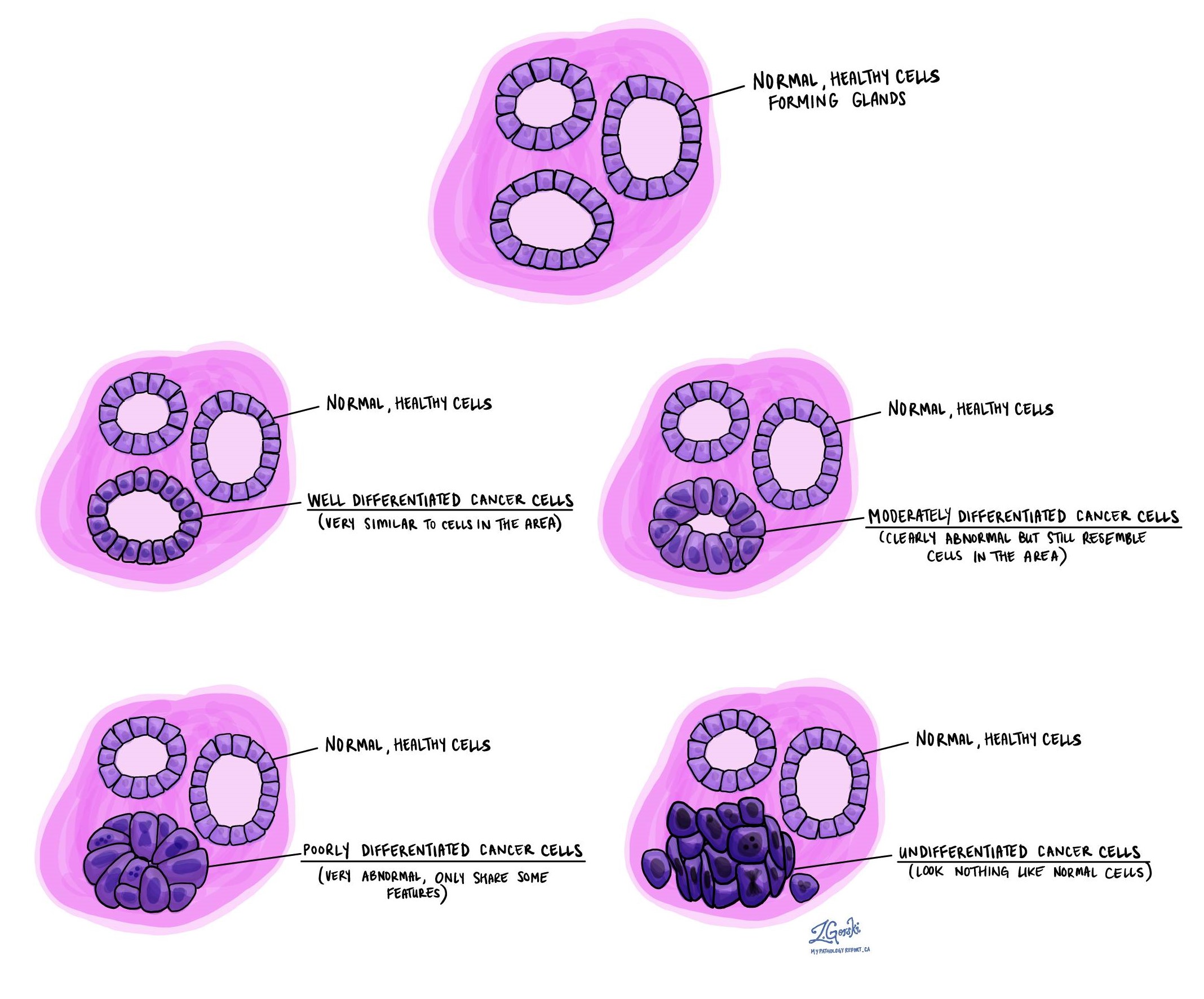
Pathologists usually classify tumor differentiation into four categories.
Well differentiated (low grade)
-
Tumor cells closely resemble normal cells.
-
Cells maintain their specialized functions and normal tissue structure.
-
Usually grow slowly and are less aggressive.
-
Often have a better prognosis and respond well to treatment.
Moderately differentiated (intermediate grade)
-
Tumor cells somewhat resemble normal cells but also show some abnormalities.
-
The structure and function of the cells are intermediate between well and poorly differentiated.
-
Have an intermediate prognosis and a moderate response to treatment.
Poorly differentiated (high grade)
-
Tumor cells appear abnormal and differ significantly from normal cells.
-
These tumors usually grow quickly and can be more aggressive.
-
Typically associated with a poorer prognosis and may be more challenging to treat.
Undifferentiated (high grade)
-
Tumor cells show no resemblance to normal cells.
-
Highly abnormal and disorganized in appearance.
-
Usually grow rapidly, behave very aggressively, and have the poorest prognosis.
-
Often difficult to treat effectively.
How do pathologists determine a tumor’s differentiation?
Pathologists determine a tumor’s differentiation by carefully examining tissue samples under a microscope. These tissue samples are typically obtained through a biopsy or surgical procedure. By analyzing the cells’ appearance, organization, and characteristics, pathologists classify the tumor into one of the differentiation categories above.
Why is differentiation important for cancer treatment?
The differentiation grade helps doctors make important decisions about treatment and predict the likely behavior of the tumor. Less differentiated tumors (high grade) may require more aggressive treatment methods, while better-differentiated tumors (low grade) may respond to less intensive treatments.
When planning treatment, doctors also consider other factors, such as:
-
Tumor size
-
Cancer stage (extent of disease)
-
Presence of specific molecular or genetic markers
By understanding differentiation and these other factors, your healthcare team can provide a personalized treatment plan that fits your unique situation.
Questions to ask your doctor:
If your pathology report mentions differentiation, you may find it helpful to ask your doctor:
-
What is the differentiation grade of my tumor?
-
How does the differentiation level affect my prognosis?
-
Will the differentiation grade influence the recommended treatment?
-
Do I need additional tests or follow-up evaluations based on the differentiation level?
Being informed about differentiation can help you feel more involved and confident in your cancer treatment decisions.