How Long Do Pathology and Lab Test Results Take?
After a biopsy, swab, or blood test, many people want to know how long results will take. Some test results come back the same day, while others take several weeks. Timing depends on the test type, the laboratory, and whether the initial review requires additional testing. A pathologist or laboratory professional must also review and sign off on every result before releasing it.
This article explains how long pathology and lab test results usually take, from routine blood tests and cultures to biopsies and genetic testing. It also explains why some results take longer, how you receive them through your doctor or patient portal, and what to do if you are still waiting.
How long do different pathology and lab tests usually take?
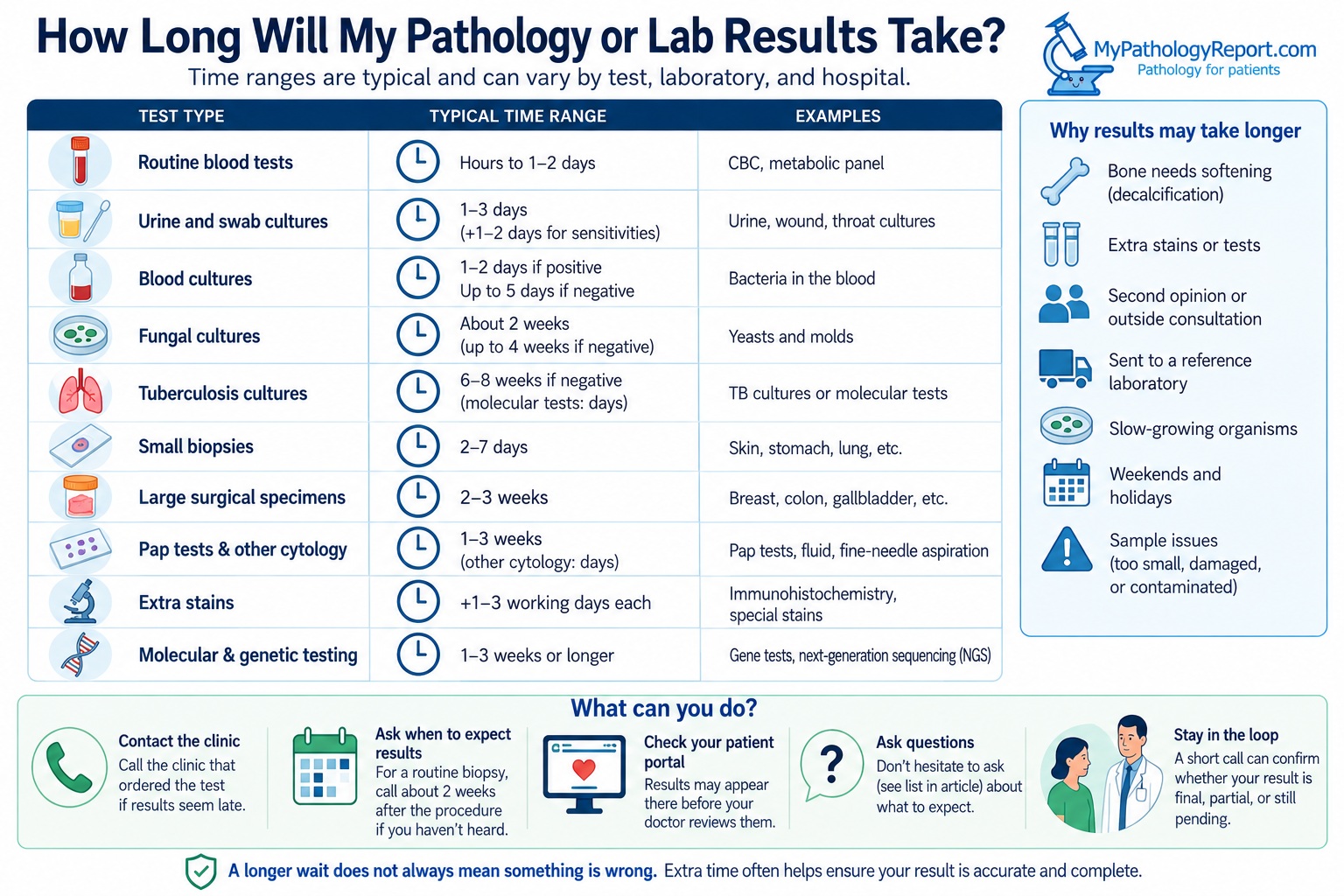
The time it takes to get pathology and lab test results back varies widely from one test to another. The ranges below are typical, but they vary by laboratory, hospital, and country. They describe the laboratory’s work and do not include the time your doctor needs to review the result and contact you.
- Routine blood tests. Common blood tests, such as a complete blood count (CBC) or a metabolic panel, are usually ready within hours to a day or two. Specialized blood tests sent to another laboratory can take a week or longer.
- Urine and swab cultures. In a culture, the laboratory grows bacteria from your sample to see which ones are present. Most urine, wound, and throat cultures take about one to three days. Identifying the bacteria and testing which antibiotics work against them can add another day or two.
- Blood cultures. When bacteria grow in a blood culture, the laboratory often knows within one to two days. A blood culture with no growth is usually watched for five days before the lab reports it as final and negative.
- Fungal cultures. Because yeasts and molds grow more slowly than most bacteria, many fungal cultures take about two weeks to report. Some laboratories keep them for up to four weeks before calling them negative.
- Tuberculosis cultures. The bacteria that cause tuberculosis (TB) grow very slowly, so a TB culture can take six to eight weeks to report as negative. Faster molecular tests can often give an early answer within a few days.
- Small biopsies. A biopsy is a small piece of tissue removed for testing. Results for a routine small biopsy, such as a skin, scalp, stomach, or lung biopsy, are often ready within about two to seven days.
- Larger surgical specimens. Tissue removed during surgery, such as a breast, colon, or gallbladder, takes longer to examine and sample. These reports usually take about two to three weeks.
- Pap tests and other cytology. Cytology looks at loose cells rather than tissue. Pap test results usually take 1 to 3 weeks. Other cytology samples, such as fluid or fine-needle aspiration, are often ready within a few days.
- Extra stains. Immunohistochemistry and special stains are extra tests done on the same tissue to answer a specific question. Each usually adds about one to three working days.
- Molecular and genetic testing. Tests that look for changes in genes, such as next-generation sequencing (NGS), often take one to three weeks. They can take longer when the sample is sent to an outside laboratory.
Professional bodies set targets for how quickly tissue reports should be finished. In the United Kingdom, the Royal College of Pathologists set a target in 2013 of 80% of tissue samples reported within 7 days and 90% within 10 days. Samples that need bone softening or molecular tests are expected to take longer. Your laboratory may have a different target, and your clinic can tell you what to expect.
Why do some pathology and lab results take longer?
When pathology or lab results take longer than expected, the sample usually needs extra work. If you are still waiting and wondering why it is taking so long, one of these reasons often applies.
- Bone and other hard tissue. Bone must be softened in a special solution before it can be cut into thin slices. This step, called decalcification, can add several days to more than a week.
- Extra stains or tests. After the first look under the microscope, the pathologist may order more tests to confirm the diagnosis, and each round of testing adds time.
- A second opinion. Pathologists often refer difficult or rare cases to another pathologist, either in the same hospital or at a specialist center. An outside consultation usually adds about three to seven working days, and sometimes more when the slides must be shipped a long way.
- Tests sent to a reference laboratory. Some tests are done at only a few specialized laboratories. Shipping the sample and waiting in that laboratory’s queue both add time.
- Slow-growing organisms. In a culture, the laboratory must wait for the organism to grow, and slow-growing bacteria, fungi, and TB cannot be hurried.
- Weekends and holidays. Many pathology laboratories process routine tissue only on working days. A biopsy taken on a Friday or before a long weekend may take a few extra days.
- A sample that cannot be tested. Occasionally a sample is too small, damaged, or contaminated to give a reliable result. The test may then need to be repeated with a new sample.
Sometimes a report is issued before every test is finished, and the outstanding parts are listed as pending. Our article on what “pending” or “additional testing required” means explains this in more detail.
Does a longer wait for results mean something is wrong?
A longer wait for pathology or lab results does not by itself mean the result is bad. Many delays come from workload, shipping, holidays, or the type of sample. A biopsy showing nothing serious can be held up by a long weekend, and a fungal or TB culture can take weeks even when nothing grows.
Some delays do reflect a more complex finding. A cancer diagnosis often needs extra stains and biomarker tests before the report is complete. Pathologists may send an unusual finding to a specialist for a second opinion. In these cases, the extra time helps make the final report as accurate and complete as possible.
How do pathology and lab results reach you?
Pathology and lab results are sent first to the doctor or clinic that ordered the test. Depending on where you receive care, you may also see them in a patient portal or health record app. Some results appear there as soon as they are signed, while others are held until your doctor has reviewed them.
In the United States, a federal rule under the 21st Century Cures Act, in effect since April 2021, requires most test results to be released to patients without delay. As a result, many people now see results in their portal before their doctor has seen them. Some states allow cancer results and other sensitive results to be delayed.
In Canada and many other countries, portal rules vary by province, hospital, and test type. Some systems release routine blood test results right away but hold biopsy reports until a doctor reviews them. A result showing in your portal does not mean your doctor has seen it, and a result your doctor has seen may not yet be in your portal.
While a test is in progress, a portal may describe it as pending, in process, or preliminary. A final result appears once every part of the test is complete and signed.
What can you do if your pathology or lab results seem late?
If your pathology or lab results seem late, contact the clinic or doctor who ordered the test first. Laboratories often cannot discuss results with patients directly, but the ordering clinic can see whether the report is finished and whether any part is still pending.
Before you leave your appointment, ask when you should expect your results and how you will receive them. If that date passes and you still have no results, call the clinic. For a routine biopsy, it’s sensible to call about two weeks after the procedure if you haven’t been told otherwise.
Do not assume that no news is good news, because results occasionally go to the wrong doctor or are filed without follow-up. A short call can confirm whether your result is final, partially complete, or still pending additional tests.
Questions to ask your doctor
- When should I expect my results, and how will I receive them?
- Will my results appear in my patient portal before you have reviewed them?
- Who should I contact if I have not heard anything by that date?
- Is my sample being tested here, or is it being sent to another laboratory?
- Have they ordered any extra stains, molecular tests, or second opinions?
- Is any part of my report still pending, and what is it waiting for?
- Is my culture final, or is it still being watched for slow-growing organisms?
- Will waiting for these results delay any decisions about my care?
- Can I start any next steps, such as imaging or referrals, while I wait?
- If my result is normal, will someone still contact me?
Related articles on MyPathologyReport.com
- What does “pending” or “additional testing required” mean in my pathology report?
- What happens after your pathology report?
- What is a cytology report?
- What is a culture and sensitivity (C&S) test?
- Urine culture: understanding your report
- Wound and sputum cultures: understanding your report
- Blood culture
- Fungal testing: understanding your report
- Tuberculosis (TB) testing: understanding your report
- Understanding next-generation sequencing (NGS) in cancer