Virus: Definition
A virus is a tiny infectious agent that can reproduce only inside a living cell. Viruses cause many illnesses, including colds, influenza, COVID-19, hepatitis, and HIV. Some viruses can also cause cancer. A pathologist may see the effects of a virus in your tissue sample, or may use special tests to find the virus itself.
This article explains what a virus is, how viruses enter the body and infect cells, how they link to cancer, and how pathologists identify them.
What is a virus?
A virus is a very small package of genetic material. It is much smaller than a bacterium. Most viruses are too small to see with an ordinary light microscope. Most viruses share three basic parts:
- Genetic material. This is either DNA or RNA. It carries the instructions for making new viruses.
- Capsid. This protein coat surrounds and protects the genetic material.
- Envelope. Some viruses have an outer layer of fat and viral proteins. Others do not.
Together, the genetic material and its coat form a viral particle.

Is a virus alive?
Scientists disagree about whether viruses are alive. Viruses carry genes, and they evolve. However, they have no cells and no metabolism of their own. They cannot make new products without a host cell. For this reason, most scientists do not call them living organisms.
How do viruses enter the body?
The route a virus takes into the body affects how it spreads and which organs it infects. The main routes are:
- Breathing. Coughing and sneezing spread droplets that carry the virus. These viruses infect the nose, throat, and lungs. COVID-19 and influenza spread this way.
- Swallowing. Contaminated food or water carries the virus into the digestive tract. Viral gastroenteritis and some forms of hepatitis spread this way.
- Direct contact. Blood, sexual contact, and birth can pass a virus from one person to another. HIV and some forms of hepatitis spread this way.
- Insect bites. Some insects carry viruses and pass them to people. West Nile virus and yellow fever virus spread this way.
What happens after a virus infects a cell?
A virus must enter a cell to reproduce. Inside the cell, it follows a cycle of five steps:
- Attachment. The virus binds to receptors on the cell surface.
- Entry. The virus enters the cell.
- Replication. The virus uses the cell’s machinery to copy its genetic material and make its proteins.
- Assembly. The new parts come together to form new viral particles.
- Release. The particles leave the cell. Some burst the cell open. Others bud out through its surface.
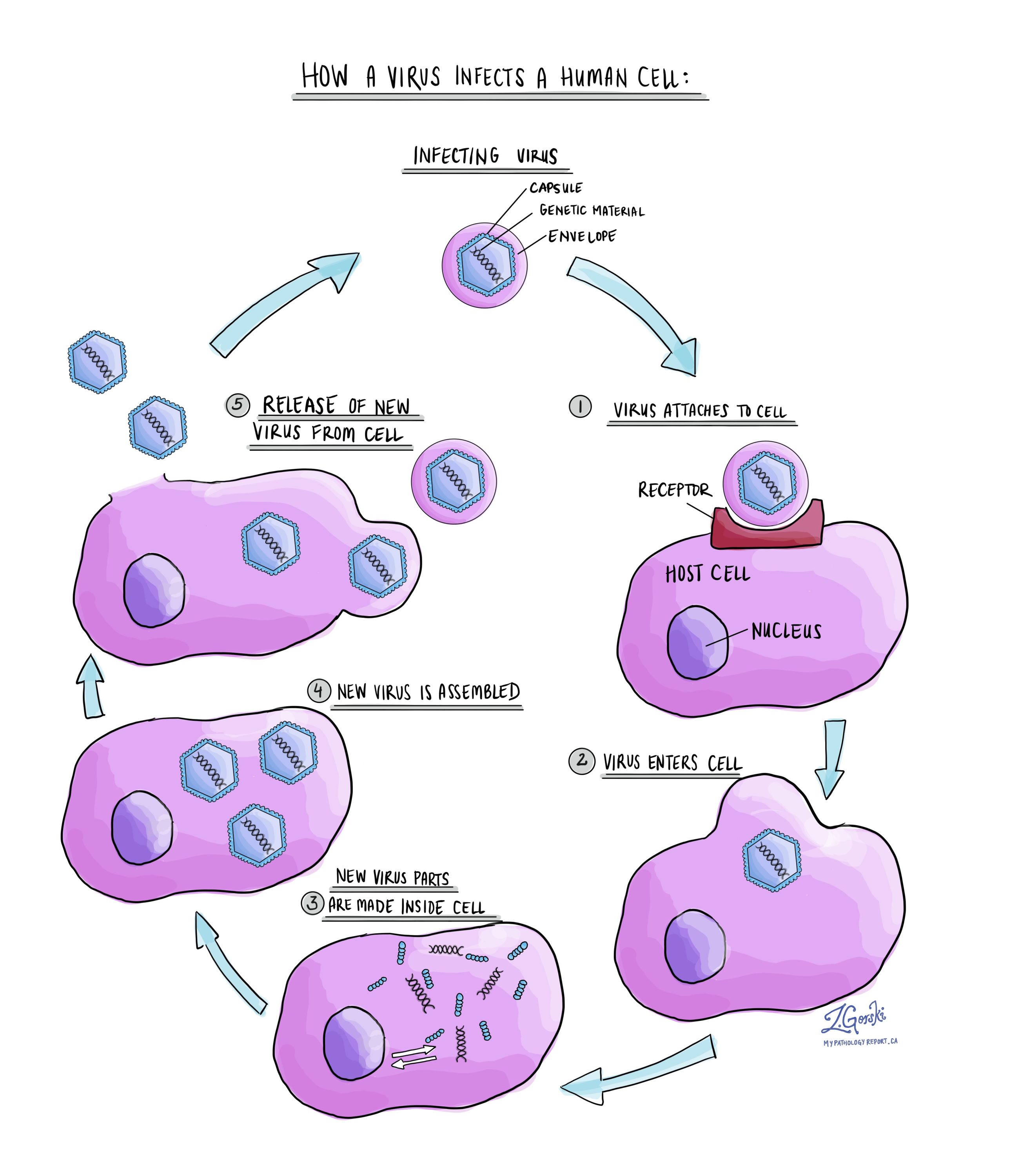
A virus can infect only cells that carry the right receptor. Doctors call this preference tropism. For example, HIV binds to a protein called CD4. This protein sits mainly on certain immune cells. Tropism explains why each virus affects only certain organs.
As viruses replicate, they change the infected cell. Pathologists can see some of these changes under the microscope. See viral cytopathic effects.
When is a person contagious?
A person is contagious when the body makes and releases new viral particles. This period differs from virus to virus. Some viruses can spread before symptoms start. Some people stop being contagious before their symptoms fully clear. Other viruses, such as blood-borne ones, can persist in the body for years.
Can viruses cause cancer?
A few viruses can lead to cancer, but most infections do not. Long-term infection increases the risk for some. Viruses linked to cancer include:
- Human papillomavirus (HPV). HPV can cause cancers of the cervix, throat, anus, and other sites. Most HPV infections clear on their own.
- Hepatitis B and hepatitis C viruses. Long-term infection with these viruses raises the risk of liver cancer. See hepatitis B testing and hepatitis C testing.
- Epstein-Barr virus (EBV). Doctors link EBV to several cancers, including Burkitt lymphoma, Hodgkin lymphoma, and nasopharyngeal carcinoma. Very few infected people develop them.
- Human herpesvirus 8 (HHV-8). HHV-8 causes Kaposi sarcoma.
How do pathologists identify viruses?
Pathologists use four main methods to find a virus or its effects:
- Microscopic changes. Viral cytopathic effects, such as inclusions and multinucleated cells, can point to a specific virus.
- Immunohistochemistry. Immunohistochemistry uses antibodies to label viral proteins in tissue.
- In situ hybridization. In situ hybridization uses a probe to find viral genetic material in the cells. Pathologists use it to detect EBV.
- Molecular tests. Polymerase chain reaction (PCR) detects viral genetic material.
Doctors also test for viruses outside the pathology laboratory. Blood and swab tests look for the virus itself or for the antibodies the body makes against it. The article on PCR, antigen, and antibody tests explains how they differ.
What might my report say about a virus?
Reports mention a virus in a few standard ways. Each laboratory phrases it a little differently:
- Viral cytopathic effect identified. The pathologist saw cell changes that point to a virus.
- Consistent with a named virus. The pathologist saw a pattern typical of a specific virus, such as HSV or CMV.
- Positive or detected. A stain, probe, or molecular test found the virus.
- Negative or not identified. The pathologist did not find the virus in the sample. The pathologist checks only the tissue in your sample, so this result lowers the concern but cannot rule out infection.
What happens after a virus is identified?
Next steps depend on the virus, the organ involved, and your overall health. Some viral infections clear on their own. Others need treatment or long-term follow-up. Your doctor can explain which applies to you. The testing for infections section describes many of the tests doctors use.
Questions to ask your doctor
- Which virus does my report mention?
- Did the pathologist confirm the virus with a stain or a molecular test?
- Does this result mean I have an active infection?
- Can I spread the virus to other people?
- Is this virus linked to cancer, and does that apply to me?
- Do I need blood tests or other tests?
- Do I need treatment, or can we watch the infection?
- Should my partner or household members get tested?