

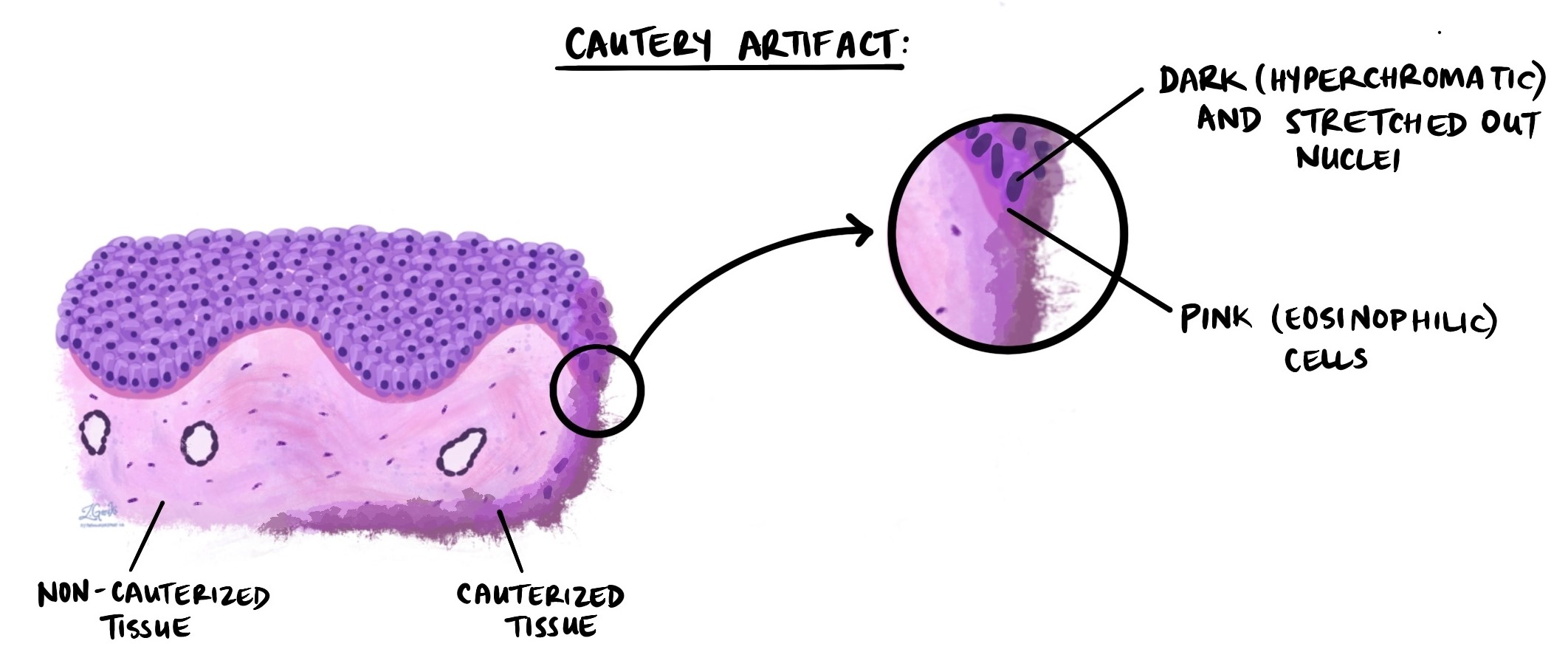
Cautery artifact is a term pathologists use to describe changes in the appearance of cells and tissue caused by heat during a surgical procedure. These changes are not related to disease, but instead result from a common surgical tool called electrocautery, which uses heat to cut tissue and stop bleeding.
Electrocautery is frequently used during biopsies and surgeries to control bleeding by sealing blood vessels. While very useful during procedures, the heat it produces can alter the appearance of the tissue, especially around the edges of the surgical specimen.
What does cautery artifact look like under the microscope?
When tissue affected by cautery is examined under the microscope, it may show:
-
Cells with pink, dense cytoplasm (the body of the cell).
-
Nuclei (the part of the cell that contains DNA) that appear darker, stretched, or irregular.
-
Sometimes, the cells may look shrunken, blurred, or fragmented.
These heat-related changes are called artifacts, meaning they are not caused by disease, but rather by the manner in which the tissue was handled or removed.
Why is cautery artifact important?
Cautery artifact can make it more difficult for the pathologist to interpret the tissue. In areas with significant artifacts, it may be challenging to determine:
-
Whether the cells are normal or abnormal.
-
Whether there are any signs of cancer or dysplasia (precancerous changes).
-
If a surgical margin (the edge of the removed tissue) is truly free of tumour.
When cautery artifact affects a critical area, the pathologist may include a note in the report explaining that evaluation was limited and that additional tissue or clinical correlation may be needed.
What does it mean for your treatment?
In most cases, cautery artifact does not affect treatment, especially if there is enough unaffected tissue for the pathologist to make a clear diagnosis. However, if the cautery changes affect important parts of the sample—such as the surgical margins or a suspicious lesion—your doctor may recommend further testing or a repeat biopsy to get a clearer result.
Questions to ask your doctor
-
Did cautery artifact affect the ability to interpret my pathology sample?
-
Are the results of my report clear despite the cautery artifact?
-
Do I need additional testing or a repeat biopsy?
We are proud to partner with:

