

Section Editor: Rodney E. Rohde PhD
October 15, 2026
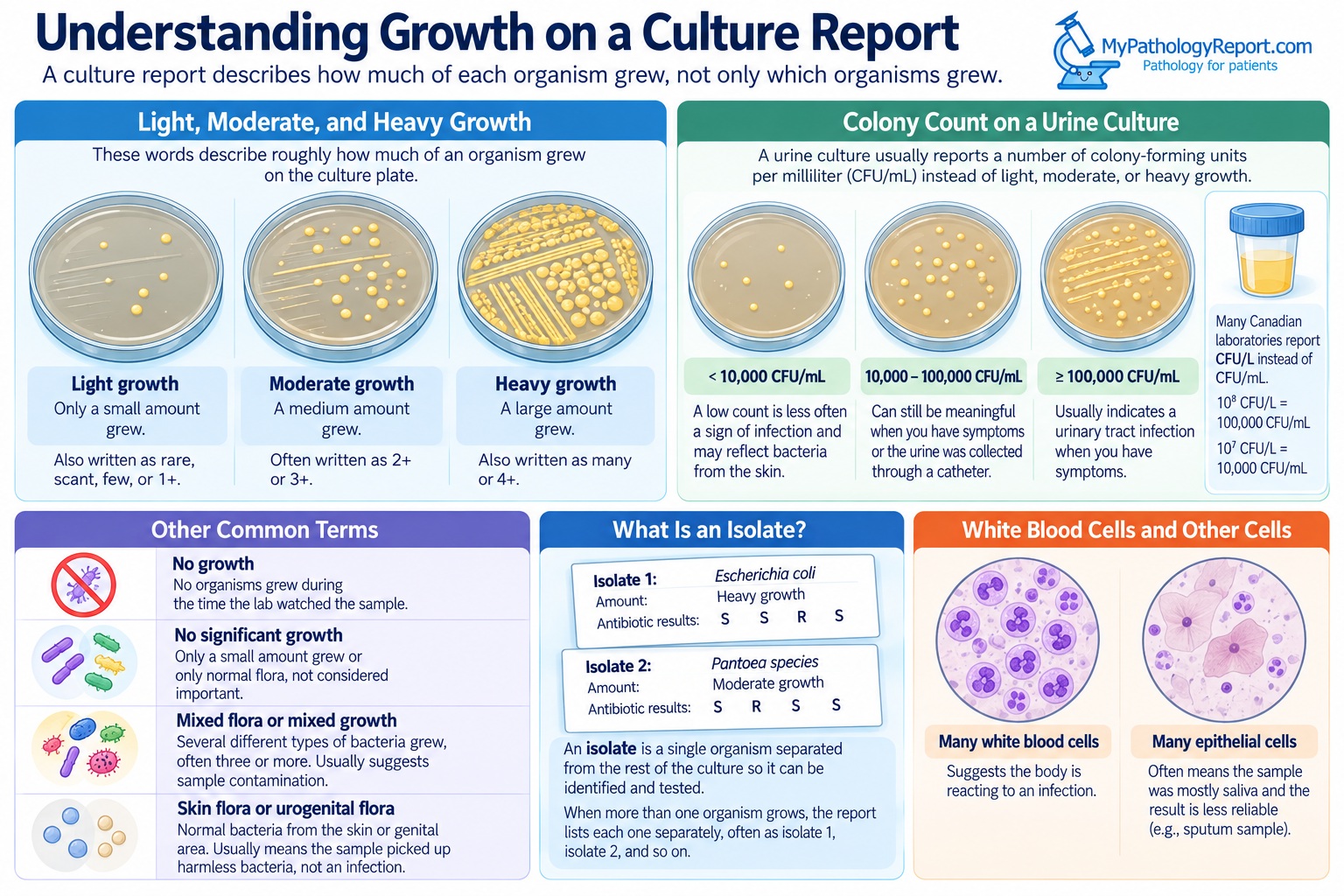
A culture report describes how much of each organism grew, not only which organisms grew. It uses words such as light growth, moderate growth, heavy growth, no growth, isolate, colony count, CFU/mL, mixed flora, skin flora, and urogenital flora. These words help your doctor decide whether bacteria on a culture are causing an infection or are simply harmless bacteria picked up with the sample.
This article explains the growth terms used in urine, wound, swab, sputum, and other culture reports. Our companion article explains the organisms themselves.
What do light, moderate, and heavy growth mean on a culture report?
Light, moderate, and heavy growth describe roughly how much of an organism grew on a culture. To estimate this, the lab spreads the sample across a culture plate in four sections, from most sample to least.
- Rare, scant, or light growth. Only a small amount grew, usually in the first section of the plate. Some reports use “few” or “1+” for this amount.
- Moderate growth. A medium amount grew and spread into the middle sections of the plate. Number grades of 2+ and 3+ fall between light and heavy growth.
- Heavy growth. A large amount grew, spreading across all four sections of the plate. Some reports use “many” or “4+.”
These words are an estimate, not an exact count, and the amount of growth does not tell you how sick you are. Heavy growth on a skin swab may mean very little. Light growth of an organism such as group A strep from a wound or throat swab can still matter. Your doctor considers the amount, the organism, the sample, and your symptoms.
What does a colony count in CFU/mL mean on a urine culture?
A urine culture usually reports a colony count in colony-forming units per milliliter (CFU/mL) instead of light, moderate, or heavy growth. Each colony on the plate grew from a single bacterium or a small clump, so the colony count estimates how many bacteria were in each milliliter of urine.
- 100,000 CFU/mL or more. A count this high for a single type of bacteria, along with symptoms such as burning or needing to pass urine often, usually indicates a urinary tract infection. It may also be written as 105 CFU/mL or “greater than 100,000.”
- 10,000 to 100,000 CFU/mL. A count in this middle range can still be meaningful when you have clear symptoms, or when the urine was collected through a catheter. Reports often give a range, such as 10,000 to 50,000 CFU/mL, because the count is an estimate.
- Less than 10,000 CFU/mL. A low count is less often a sign of infection and may reflect bacteria from the skin. Your doctor may still consider it if you have clear symptoms or the sample was taken by catheter.
Many Canadian laboratories report urine colony counts per liter (CFU/L) instead of per milliliter. A count of 108 CFU/L is the same as 100,000 CFU/mL, and 107 CFU/L is the same as 10,000 CFU/mL. These numbers are guidelines, not firm cutoffs, and the urine culture article explains when bacteria in the urine don’t need treatment.
What do “no growth” and “no significant growth” mean on a culture report?
“No growth” on a culture report means that no organisms grew from the sample during the time the laboratory watched it. A preliminary report may say “no growth at 24 hours” or “no growth at 48 hours” before the lab issues a final report.
“No significant growth” means that something grew, but only in a small amount, or only normal flora that is not considered important. A culture with no growth does not rule out every infection, because some organisms, such as viruses, do not grow on routine culture. Antibiotics taken before the sample was collected can also stop bacteria from growing.
What does “isolate” mean on a culture report?
An isolate is a single organism the laboratory separates from the rest of the culture so it can be identified and tested. When more than one organism grows, the culture report lists each one separately, often as “isolate 1” and “isolate 2,” with its own name, amount, and susceptibility results.
Sometimes two isolates have the same name, such as two isolates of Pantoea or E. coli. This usually means two slightly different strains of the same organism grew, often with different antibiotic results. Two isolates do not, by themselves, mean the infection is more serious.
What do mixed flora, normal flora, skin flora, and urogenital flora mean?
On a culture report, “flora” means the bacteria that normally live in a part of the body. Finding normal flora on a culture usually suggests the sample picked up harmless bacteria, not an infection.
- Normal flora. These are the harmless bacteria expected in the sampled area. A throat or sputum culture often grows normal oral or respiratory flora from the mouth.
- Skin flora. These are bacteria that normally live on the skin, such as coagulase-negative staphylococci and diphtheroids. Skin flora in a wound, blood, or urine culture often means the sample touched the skin during collection.
- Urogenital flora. These are bacteria that normally live around the opening of the urethra and the genital area. A result such as 10,000 to 50,000 CFU/mL of mixed urogenital flora usually means the urine picked up these bacteria on the way out. It rarely means a bladder infection.
- Mixed flora or mixed growth. Several different types of bacteria grew, often three or more. Because a true infection is usually caused by one or two types, mixed growth most often points to sample contamination. The report may say “probable contamination” and suggest collecting a new sample if symptoms continue.
What do white blood cells and other cells mean on a culture report?
Many culture reports include a Gram stain, which looks at the sample under the microscope before anything grows. The Gram stain may describe white blood cells as few, moderate, or many.
White blood cells show that the body is reacting to something, so bacteria growing alongside moderate or many white blood cells more likely reflect a real infection. For example, heavy Staphylococcus aureus growth with moderate white blood cells in a wound points more strongly to infection than either finding alone. In a sputum sample, many epithelial cells from the mouth suggest the sample was mostly saliva, which makes the culture result less reliable.
What happens after the culture report?
After the culture report describes the growth, the laboratory tests antibiotics against organisms likely to be causing the infection. The results are reported as susceptible, intermediate, or resistant, and the culture and sensitivity (C&S) test article explains what each means.
Your doctor uses the amount of growth, the organism, the sample type, and your symptoms to decide what to do next. If the result suggests contamination or mixed flora and you still have symptoms, a new, carefully collected sample may be the next step.
Questions to ask your doctor
- How much of the organism grew on my culture?
- What does the colony count on my urine culture mean for me?
- Does my result look like an infection, colonization, or contamination?
- What does mixed flora or skin flora on my report mean?
- Why does my report list more than one isolate?
- Were white blood cells seen on the Gram stain?
- Is my culture final, or is it still preliminary?
- Do I need to give a new sample?
- Was susceptibility testing done, and what did it show?
- What symptoms should make me call you?
Related articles on MyPathologyReport.com
- What is a culture and sensitivity (C&S) test?
- Urine culture: understanding your report
- Wound and sputum cultures: understanding your report
- Blood culture
- Throat culture and strep testing: understanding your report
- Gram stain: understanding your report
- How long do pathology and lab test results take?
We are proud to partner with:


🔍 Search MyPathologyReport
Type what you see on your report — for example a diagnosis or test name