

Section Editor: Andrew Lingard MD, FRCPC
October 27, 2026
Genetic testing looks for changes in a person’s DNA that can explain a health condition, predict a future one, or show how the body handles certain medicines. This article is about genetic testing for conditions other than cancer. These include inherited disorders of the heart, muscles, nerves, blood, and metabolism, as well as conditions that affect a child’s growth and development.
You may be reading this because you or your child had a genetic test, or because a relative was found to carry a genetic change. Some people are tested because they have symptoms, and others are tested even when they feel completely well. This article explains the main types of genetic tests used for conditions other than cancer and what a genetic test report can include. It also explains what each result means and what you can do with the information afterward.
Our articles on genetic testing in cancer and hereditary cancer syndromes cover tumor testing and testing for inherited cancer risk.
Why is genetic testing done for conditions other than cancer?
Doctors order genetic testing for conditions other than cancer for several reasons. The reason matters, because it shapes which test is chosen and how the result is read.
- Diagnostic testing. This is done when a person has symptoms or test findings that suggest a genetic condition. The goal is to find the cause, because a confirmed cause can end a long search for answers and help guide care.
- Predictive testing. This is done for a person without symptoms who has a relative with a known genetic condition. It shows whether the person carries the same change before any symptoms appear.
- Carrier testing. This looks for changes that usually cause no symptoms in the carrier but could affect their children. It is often offered before or during a pregnancy.
- Prenatal and newborn testing. Prenatal tests examine DNA from a pregnancy. Newborn screening programs check a small blood sample from every baby for treatable conditions, and some programs include DNA tests.
- Pharmacogenomic testing. This looks for inherited differences in how the body processes certain medicines. The result can affect which drug is chosen or what dose is used.
One genetic test can serve multiple purposes. A test ordered to explain a child’s symptoms can also reveal information that matters for the parents and siblings.
How inherited genetic changes are passed on
Genetic testing for conditions other than cancer usually examines germline DNA. This is the DNA a person is born with, and it is present in nearly every cell of the body. A germline change can be passed from parent to child. It differs from a somatic change, which develops later in life in one tissue (such as a tumor) and is not inherited.
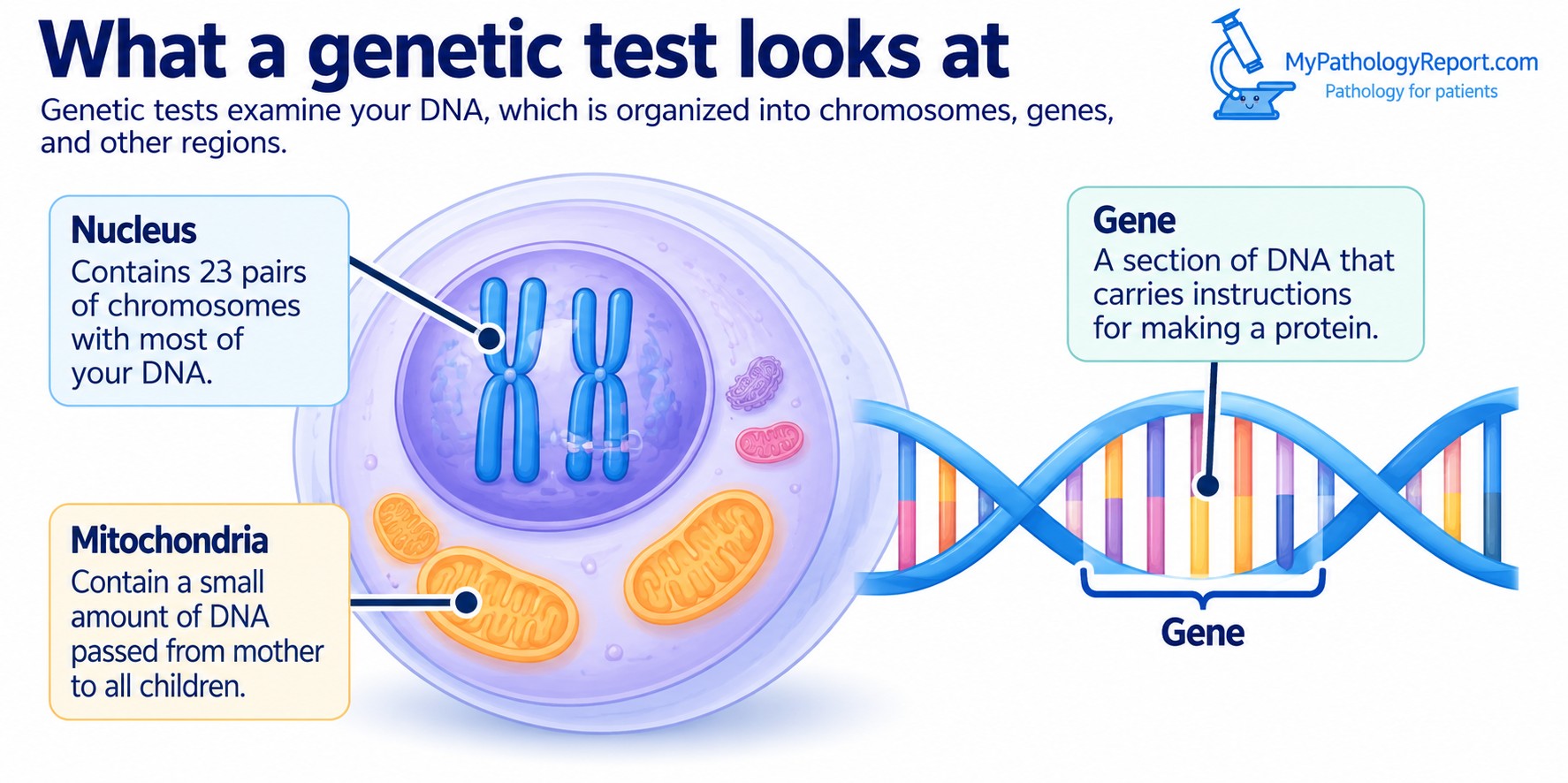
Most of your DNA is packaged into 23 pairs of chromosomes inside the center of each cell. You inherit one chromosome of each pair from each parent. A gene is a section of DNA that carries the instructions for making a protein. How a genetic condition moves through a family depends on how many working copies of a gene the body needs.
- Dominant. One changed copy of the gene is enough to cause the condition. A parent with a dominant condition has a 1 in 2 chance of passing the change to each child.
- Recessive. The condition appears only when both copies of the gene are changed. A person with one changed copy is called a carrier and usually has no symptoms. When both parents are carriers, each child has a 1 in 4 chance of having the condition.
- X-linked. The gene sits on the X chromosome. Males have one X chromosome, so a single changed copy usually causes the condition. Females have two X chromosomes and are often carriers, although some carriers do have symptoms.
- Mitochondrial. A small amount of DNA sits outside the cell center, inside structures called mitochondria. Mitochondrial DNA is passed down only from mother to child. This pattern is explained in more detail below.
- New (de novo). Some changes appear for the first time in a child and are not present in either parent. Testing both parents usually reveals this.
Types of genetic tests
Several different genetic tests are used for conditions other than cancer. Each one looks at DNA differently, and each one can miss certain kinds of changes. Your genetic test report should name the test that was performed.
- Targeted variant test. This checks for one specific change that is already known in the family. It is the usual test for relatives once a change has been found. It gives a clear answer for that one change but does not look at anything else.
- Single-gene test. This reads all of one gene. It is used when symptoms strongly point to one condition, such as sickle cell disease.
- Gene panel. This reads a group of genes linked to one type of problem, such as heart rhythm disorders, epilepsy, or hearing loss. Panels can include a handful of genes or several hundred. Larger panels find more answers, but they also find more uncertain results.
- Chromosomal microarray. This looks for missing or extra pieces of DNA across all of the chromosomes. These are called copy number variants, and a microarray is often the first test for a child with developmental delay or several differences present at birth.
- Karyotype. This is a picture of a person’s chromosomes under the microscope. It detects an extra or missing chromosome, as in Down syndrome, and large rearrangements, but it misses small changes.
- Exome sequencing. This reads the parts of nearly all genes that carry protein instructions. These parts are a small fraction of the DNA but contain most known disease-causing changes. It is often done together with both parents, called trio testing, which makes the results easier to interpret.
- Genome sequencing. This reads nearly all of a person’s DNA, including the regions between genes. It can detect many of the changes that other tests find separately. It also produces the most information to interpret.
- Mitochondrial DNA testing. This reads the DNA inside the mitochondria separately. Many gene panels and exome tests don’t include it unless you specifically request it.
- Specialized tests. Some conditions are caused by changes that standard sequencing handles poorly. Examples include long repeated stretches of DNA, as in fragile X syndrome and Huntington disease. These conditions need dedicated tests.
Exome, genome, and panel tests rely on next-generation sequencing (NGS), which reads millions of short DNA pieces at once. No single genetic test finds every kind of change. A result saying nothing was found applies only to what the test could see.
Mitochondrial DNA testing
Mitochondrial DNA testing examines the DNA inside mitochondria, the tiny structures that produce energy inside cells. Each cell contains hundreds to thousands of mitochondria, and each one carries its own small loop of DNA containing 37 genes. Most of the proteins mitochondria need are made from genes in the center of the cell, so that a change in either place can cause a mitochondrial condition.
Mitochondrial DNA is passed from a mother to all of her children, but fathers do not pass on their mitochondrial DNA. As a result, relatives connected through the mother’s side, such as a mother, her children, her sisters and brothers, and her sisters’ children, usually share the same mitochondrial DNA.
Reports of mitochondrial DNA testing often use two words that do not appear on other genetic tests.
- Homoplasmic. Every copy of the mitochondrial DNA that was tested carries the change.
- Heteroplasmic. Only some copies carry the change. The report may give a percentage, called the heteroplasmy level. This level can differ between tissues, such as blood and muscle, and between members of the same family. Higher levels often cause more severe problems, though this varies by variant.
Tissues that use the most energy depend most on mitochondria. For this reason, mitochondrial conditions often affect the brain, muscles, heart, eyes, and ears. Mitochondrial DNA testing sometimes needs a sample of muscle, skin, or urine cells in addition to blood, because some changes are easier to detect in certain tissues.
How the test is performed
Most genetic tests for conditions other than cancer use a blood or saliva sample. Some use a cheek swab, a skin biopsy, or a small piece of muscle. The laboratory extracts DNA from the cells and reads it using one of the methods described above. A pathologist or laboratory geneticist then reviews the findings and writes the report.
Results from a test for a single known change may take days to a few weeks. Exome or genome sequencing results often take several weeks to a few months. Our article on how long laboratory results take explains why some tests take longer than others.
Genetic testing is usually arranged through a genetics clinic or a specialist who discusses the test with you first. This conversation, called pre-test counseling, covers what the test can and can’t find, and what the results could mean for your relatives.
How results are reported
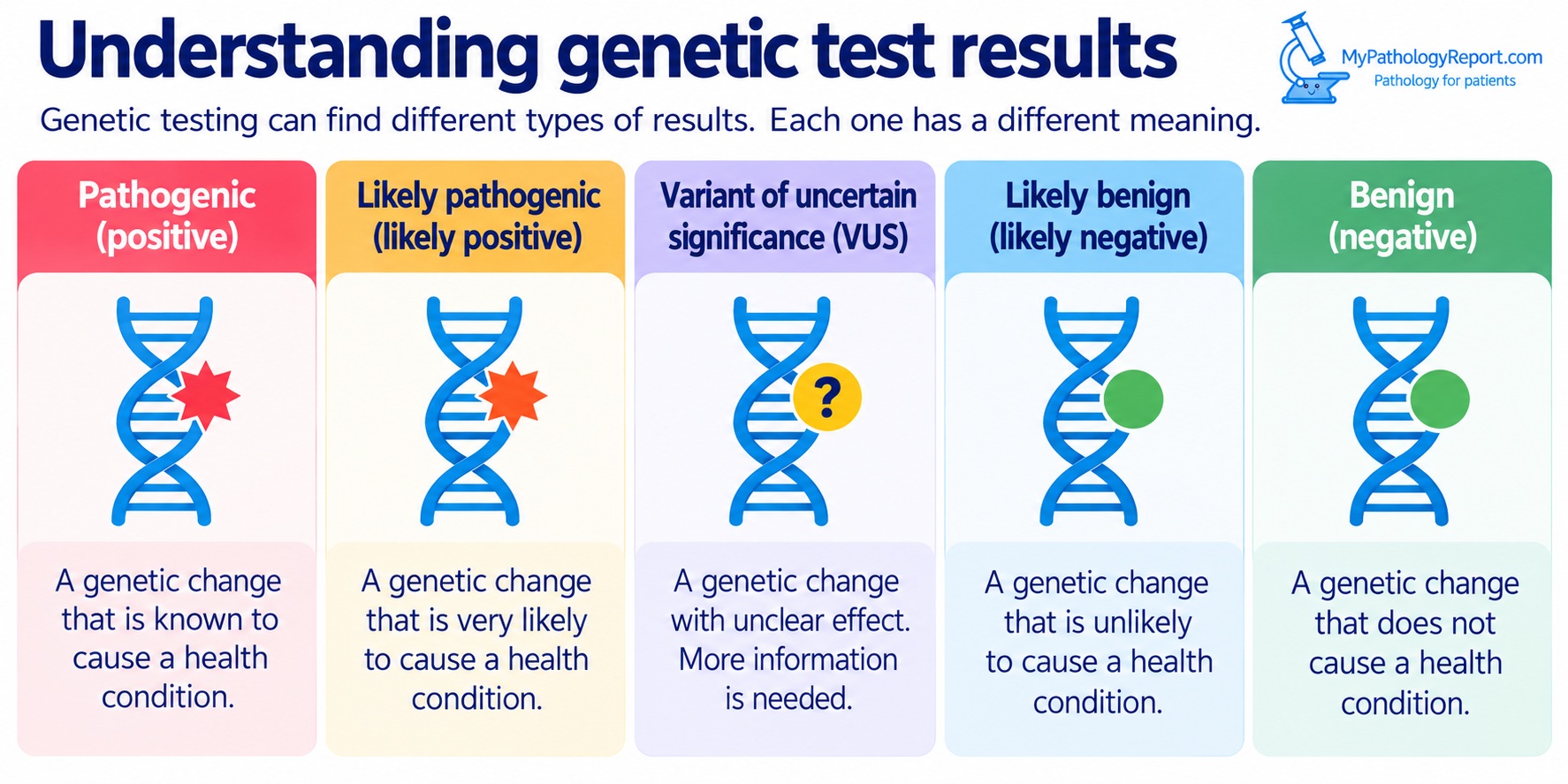
Every genetic change listed on a genetic test report is placed into one of five categories. These categories come from standards published in 2015 by the American College of Medical Genetics and Genomics (ACMG) and the Association for Molecular Pathology (AMP).
- Pathogenic. Strong evidence indicates the change causes the condition, so this is a positive result.
- Likely pathogenic. There is good evidence, but not complete proof, that the change causes the condition. Care teams usually treat it the same way as a pathogenic result.
- Variant of uncertain significance. There isn’t enough evidence to draw a definitive conclusion. This is neither a positive nor a negative result.
- Likely benign. Good evidence suggests the change is harmless.
- Benign. Strong evidence that the change is harmless. Benign changes are usually not listed on the report.
These categories describe how strong the evidence is, not how serious the condition is. Everyone carries millions of small differences in their DNA, and almost all of them are harmless. Laboratories filter out common harmless differences and report only the changes that could matter.
How to read the variant described on your report
A genetic test report describes each listed variant using a standard set of details. Knowing what each detail means makes the genetic test report much easier to follow.
- Gene. This is the name of the gene where the change was found. Gene names are usually written in capital letters, such as CFTR or RYR1.
- Variant name. This is a short code for the exact change. A name starting with “c.” describes the change in the gene, and “p.” describes its effect on the protein. A name starting with “m.” describes a change in mitochondrial DNA. For example, c.1234G>A would mean that position 1,234 of the gene has the letter A where most people have a G.
- Zygosity. This describes how many copies of the gene carry the change. Heterozygous means one of two copies, and homozygous means both copies carry the same change. Hemizygous means only one copy carries it, as with X-linked genes in males. Compound heterozygous means two different changes, one in each copy of the same gene.
- Inheritance pattern. This describes how the condition linked to the gene passes through families, such as dominant, recessive, X-linked, or mitochondrial.
- Classification. This shows where the variant sits on the five-category scale described above.
- Interpretation. This short paragraph explains whether the result accounts for why the test was ordered. It is usually the most useful part of the report to go over with your care team.
Keep a record of the exact variant name, because any future doctor or laboratory will need it to look up your result.
What a positive result means
A positive genetic test result means the test found a pathogenic or likely pathogenic variant. When that variant fits the person’s symptoms and the expected inheritance pattern, it usually confirms a genetic diagnosis.
A confirmed genetic diagnosis can guide care in several ways. It can point to a specific treatment or diet, identify other organs that need monitoring, and explain what to expect over time. It also shows which relatives may benefit from testing. For some families, it ends years of uncertainty.
A positive result does not always predict how severe a condition will be. Two people with the same variant, even within one family, can be affected very differently, which doctors call variable expressivity. Some people with a pathogenic variant never develop symptoms at all, which is called reduced penetrance.
A carrier result is a different kind of positive result. It means one copy of a gene linked to a recessive condition is changed. Carriers of recessive conditions usually stay healthy, so the result matters mainly for family planning and for relatives who may also be carriers.
What a negative result means
A negative genetic test result means the test found no pathogenic or likely pathogenic variant. What that tells you depends on why you had the test.
- True negative. A specific variant was already known in your family, and you do not carry it. For that condition, your risk is the same as anyone else’s, and you cannot pass the variant on to your children.
- Uninformative negative. No one in the family has been found to have a cause. The test ruled out only the changes it could detect. A genetic cause may still be present. It could lie in a gene not tested, a change the test cannot see, or a gene not yet linked to disease.
For children with a suspected genetic condition, published studies find a cause with exome or genome sequencing in roughly 3 to 4 out of every 10 cases. A negative result is therefore common, and it does not end the search for an explanation. Researchers can reanalyze exome and genome data later. New links between genes and diseases are discovered every year, and a second look at the same data sometimes finds an answer that was not possible before.
What a variant of uncertain significance means
A variant of uncertain significance, usually shortened to VUS, means the laboratory found a genetic change but cannot yet say whether it causes disease. It is a common result on genetic tests for conditions other than cancer, especially on large gene panels and on exome and genome sequencing. Our separate article on variants of uncertain significance describes this result in more detail.
A variant usually stays uncertain because it is rare. The laboratory may have seen it in only a few people, or not at all. It may sit in a gene whose link to disease is still being worked out. People whose ancestry is poorly represented in genetic databases are more likely to receive this result.
A VUS is not a diagnosis, and care teams usually don’t base major decisions on a VUS alone. Instead, they rely on symptoms, examination findings, family history, and other test results. Unexplained symptoms still deserve attention and follow-up, whatever the genetic report says.
Many variants are reclassified as new evidence becomes available. In published studies, most reclassified variants move toward benign. Roughly 1 to 2 of every 10 reclassified variants move the other way, toward pathogenic. Reclassification can take months or many years, and some variants are never resolved. Occasionally a variant that once seemed unimportant turns out to matter, which is one reason to keep the full report.
Several kinds of evidence can help settle what a VUS means.
- Testing parents and other relatives. A variant that is new in a child with symptoms, and absent in both healthy parents, is more likely to matter. A variant also found in healthy relatives is less likely to matter. The genetics team arranges these family studies.
- Matching the variant to the symptoms. A VUS in a gene that explains a person’s exact symptoms carries more weight than one in an unrelated gene.
- Additional laboratory tests. Some genes can be checked indirectly, for example by measuring an enzyme the gene makes or by studying muscle or skin cells.
- Shared databases. Laboratories pool their findings in international databases such as ClinVar, so evidence from other families builds up over time.
Genetic results that affect medicines and anesthesia
Some genetic test results matter most when a person receives a medicine or an anesthetic. Knowing these results in advance can prevent serious harm, even in a person who feels completely well.
- Malignant hyperthermia susceptibility. Changes in the RYR1 or CACNA1S genes can cause a dangerous reaction to certain inhaled anesthetics and to the muscle relaxant succinylcholine. The reaction includes a rapid rise in body temperature and muscle rigidity. When the risk is known in advance, the anesthesia team can choose different drugs.
- Drug-processing genes. Inherited changes in genes such as TPMT, NUDT15, and DPYD affect how the body breaks down certain medicines. Our articles on TPMT and NUDT15 testing and DPYD testing explain these results.
- Mitochondrial changes. People with some mitochondrial conditions can be more sensitive to anesthesia and to the stress of fasting before surgery. Knowing about the condition helps the anesthesia team plan.
If one of these results appears on your genetic test report, or on a close relative’s report, tell every doctor, dentist, and surgical team before a procedure.
Secondary findings
Exome and genome sequencing read thousands of genes at once, so they can uncover genetic changes unrelated to the reason for testing. These are called secondary findings or incidental findings.
The ACMG publishes a list of genes for which laboratories offer to report secondary findings. The list covers conditions where knowing in advance can change care. Examples include inherited heart rhythm disorders, very high cholesterol, malignant hyperthermia, and some inherited cancer syndromes. The list is reviewed and updated regularly, so the genes it includes change over time.
You can usually choose whether to receive secondary findings before the test. Only pathogenic and likely pathogenic variants in these genes are reported as secondary findings.
What you can do with your genetic test result
A genetic test result stays relevant for life, because the DNA you were born with does not change. These steps help make sure your genetic test result keeps working for you and your family.
- Keep a full copy of the report. Store the complete report, not just a summary. A future doctor will need the gene, the variant name, and the laboratory name.
- Share it with every doctor who treats you. This includes your family doctor, your specialists, and any surgical or anesthesia team. Results stored in one hospital’s records may not be visible at another.
- Ask whether the result affects any medicine or anesthetic. This matters most for drug-processing genes, malignant hyperthermia susceptibility, and mitochondrial changes.
- Ask how you will learn about a reclassification. Some laboratories automatically notify the ordering doctor, and others do not. Keep your contact details up to date with the genetics clinic.
- Ask about reanalysis. After a negative or uncertain exome or genome result, a second look at the same data every few years can find answers as new genes are discovered.
- Tell relatives who may be affected. A positive result can matter for parents, brothers and sisters, and children. Many genetics clinics provide a family letter that explains the result.
- Ask about a medical alert bracelet or wallet card. These can help when a confirmed result affects emergency care, as with malignant hyperthermia susceptibility or some metabolic conditions.
- Ask for genetic counseling. A genetic counselor can explain the result in detail and help you decide what to share with your family.
Testing family members
Once a genetic test finds a pathogenic or likely pathogenic variant, relatives can be tested for that exact change. This is called cascade testing, and it is usually faster, simpler, and less expensive than the first test.
Which relatives may benefit depends on the inheritance pattern. For a dominant condition, parents, brothers and sisters, and children each have a 1 in 2 chance of carrying the variant. For a mitochondrial variant, relatives on the mother’s side of the family may share it.
Testing relatives for a variant of uncertain significance is different. It does not tell those relatives anything about their own health. The genetics team may still ask to test specific relatives to help classify the variant.
Testing children with no symptoms is usually offered when the result would change their childhood care. For conditions that begin in adulthood and have no early treatment, testing is often left until the child is old enough to decide.
Genetic privacy and insurance
Many people worry about who can see their genetic test results and how those results might be used. The protections depend on where you live.
- United States. The Genetic Information Nondiscrimination Act (GINA), passed in 2008, prevents health insurers and most employers from using genetic information against you. It does not cover life, disability, or long-term care insurance. Some states have added further protections.
- Canada. The Genetic Nondiscrimination Act, passed in 2017, makes it an offense to require a genetic test, or its results, as a condition of a contract or service, including insurance. The Supreme Court of Canada upheld the law in 2020.
Rules differ in other countries, and a genetic counselor can explain the protections that apply where you live, before or after testing.
Questions to ask your doctor
- What type of genetic test was done, and what kinds of changes could it miss?
- Was my mitochondrial DNA included in the test?
- Does this result explain my symptoms, or my child’s symptoms?
- Is the variant on my report pathogenic, likely pathogenic, or of uncertain significance?
- If the result is a variant of uncertain significance, how will decisions about my care be made while it remains uncertain?
- Would testing my parents or other relatives help classify this variant?
- How will I find out if the classification of this variant changes?
- Should my exome or genome data be reanalyzed, and when?
- Does this result affect any medicines or anesthetics I might receive?
- Which relatives might benefit from testing, and how should I tell them?
- Did I agree to receive secondary findings, and were any found?
- Could my ancestry have affected how this result was interpreted?
- Can I meet with a genetic counselor to go over this result?
Related articles on MyPathologyReport.com
- Variants of uncertain significance (VUS)
- Understanding genetic testing in cancer
- What is a hereditary cancer syndrome?
- Understanding next-generation sequencing (NGS) in cancer
- TPMT and NUDT15 testing: understanding your results
- DPYD testing: understanding your results
- Understanding your hemoglobin disorder tests
- Gene
- Mutation
- Karyotype
- Molecular testing
We are proud to partner with:


🔍 Search MyPathologyReport
Type what you see on your report — for example a diagnosis or test name